


Timing is everything!
Jun. 12th, 2026 07:43 pm![[personal profile]](https://www.dreamwidth.org/img/silk/identity/user.png) luzribeiro
luzribeiroAn image reportedly posted by Donald Trump on his Truth Social platform has caused a stir, considering June is Pride Month. An inadvertent celebration? ;-)
( THE IMAGE )
More about this HERE.
( THE IMAGE )
More about this HERE.

Friday LOLs. Timing is everything!
Jun. 12th, 2026 07:42 pmluzribeiro posting in ![[community profile]](https://www.dreamwidth.org/img/silk/identity/community.png) talkpolitics
talkpoliticsAn image reportedly posted by Donald Trump on his Truth Social platform has caused a stir, considering June is Pride Month. An inadvertent celebration? ;-)
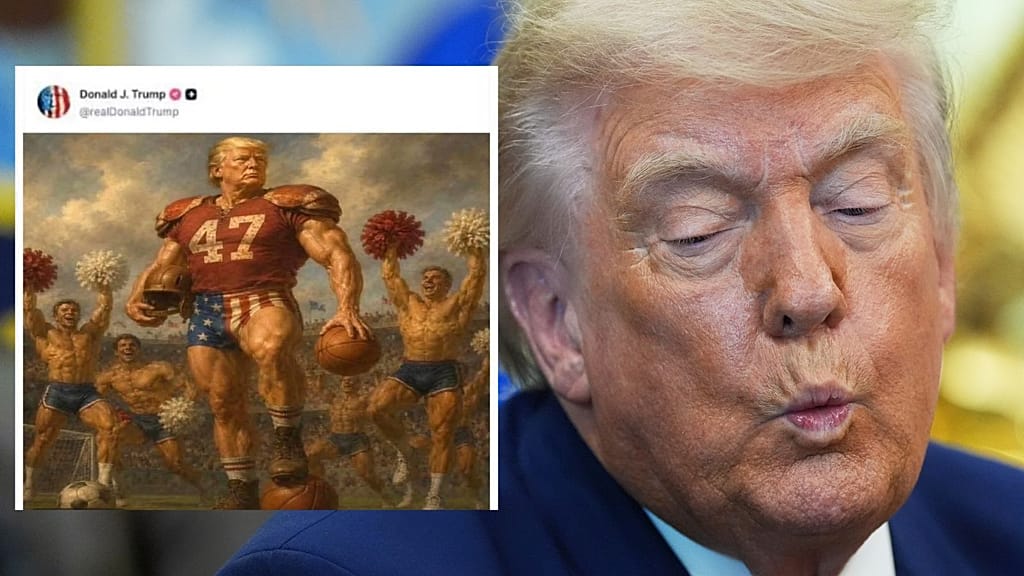
More about this HERE.
More about this HERE.
Russia: The collapse has begun
Jun. 11th, 2026 03:08 pmfridi posting in talkpolitics
In my view, Putin's Russia is heading toward an inevitable breakdown: economically, politically, administratively, and socially. The crisis is already here, and the system neither has the tools nor the willingness to deal with it.
In politics and society, there aren't many absolute laws like the laws of physics. But some patterns are so consistent that they might as well be laws. We know about Robert Michels' "Iron Law of Oligarchy": the idea that every organization tends to become oligarchic over time. Looking at Russia today, I think we're once again seeing what could be called the "Iron Law of Tyranny's Collapse".
( Read more... )
Big Baby throws a tantrum. Again.
Jun. 8th, 2026 08:29 pmluzribeiroDonald Trump loves to say women are "too emotional" to be president, but the second a female journalist calmly challenges him on his election lies, he turns bright red, rips off his mic, and storms out of the room. Like a toddler denied a toy, he threw a tantrum and crashed out of an NBC interview rather than answer a basic question about his own claims.
( Read more... )
( Read more... )
Big Baby throws a tantrum. Again.
Jun. 8th, 2026 08:29 pmluzribeiro posting in talkpoliticsDonald Trump loves to say women are "too emotional" to be president, but the second a female journalist calmly challenges him on his election lies, he turns bright red, rips off his mic, and storms out of the room. Like a toddler denied a toy, he threw a tantrum and crashed out of an NBC interview rather than answer a basic question about his own claims.
Joyce Carol Oates nailed it: this is the face of a man who is never challenged, whose worldview is never questioned, who "literally never hears a syllable of opposition unless a journalist, usually a woman, questions him, and then he is astonished and infuriated". That's exactly what we just watched with Kristen Welker: a professional woman doing her job, and a sitting president so unused to accountability that he melted down on national TV when confronted with reality.
So let's be very clear: the person calling women "too emotional" to lead is the same man who cannot sit through a single tough interview without lashing out, crying "crooked media" and bolting for the exit. This isn't strength. It isn't leadership. It's entitlement, misogyny, and cowardice dressed up as bravado, and the only reason he gets away with it is because too many people have been trained never to tell him "no".
If Trump thinks women are too "emotional" to be president, then let's have that conversation honestly: because the only person who just lost control on national television, in front of the whole country, wasn't the woman in the room.
Joyce Carol Oates nailed it: this is the face of a man who is never challenged, whose worldview is never questioned, who "literally never hears a syllable of opposition unless a journalist, usually a woman, questions him, and then he is astonished and infuriated". That's exactly what we just watched with Kristen Welker: a professional woman doing her job, and a sitting president so unused to accountability that he melted down on national TV when confronted with reality.
So let's be very clear: the person calling women "too emotional" to lead is the same man who cannot sit through a single tough interview without lashing out, crying "crooked media" and bolting for the exit. This isn't strength. It isn't leadership. It's entitlement, misogyny, and cowardice dressed up as bravado, and the only reason he gets away with it is because too many people have been trained never to tell him "no".
If Trump thinks women are too "emotional" to be president, then let's have that conversation honestly: because the only person who just lost control on national television, in front of the whole country, wasn't the woman in the room.
What rules could football adopt from rugby?
Jun. 5th, 2026 09:48 pmabomvubuso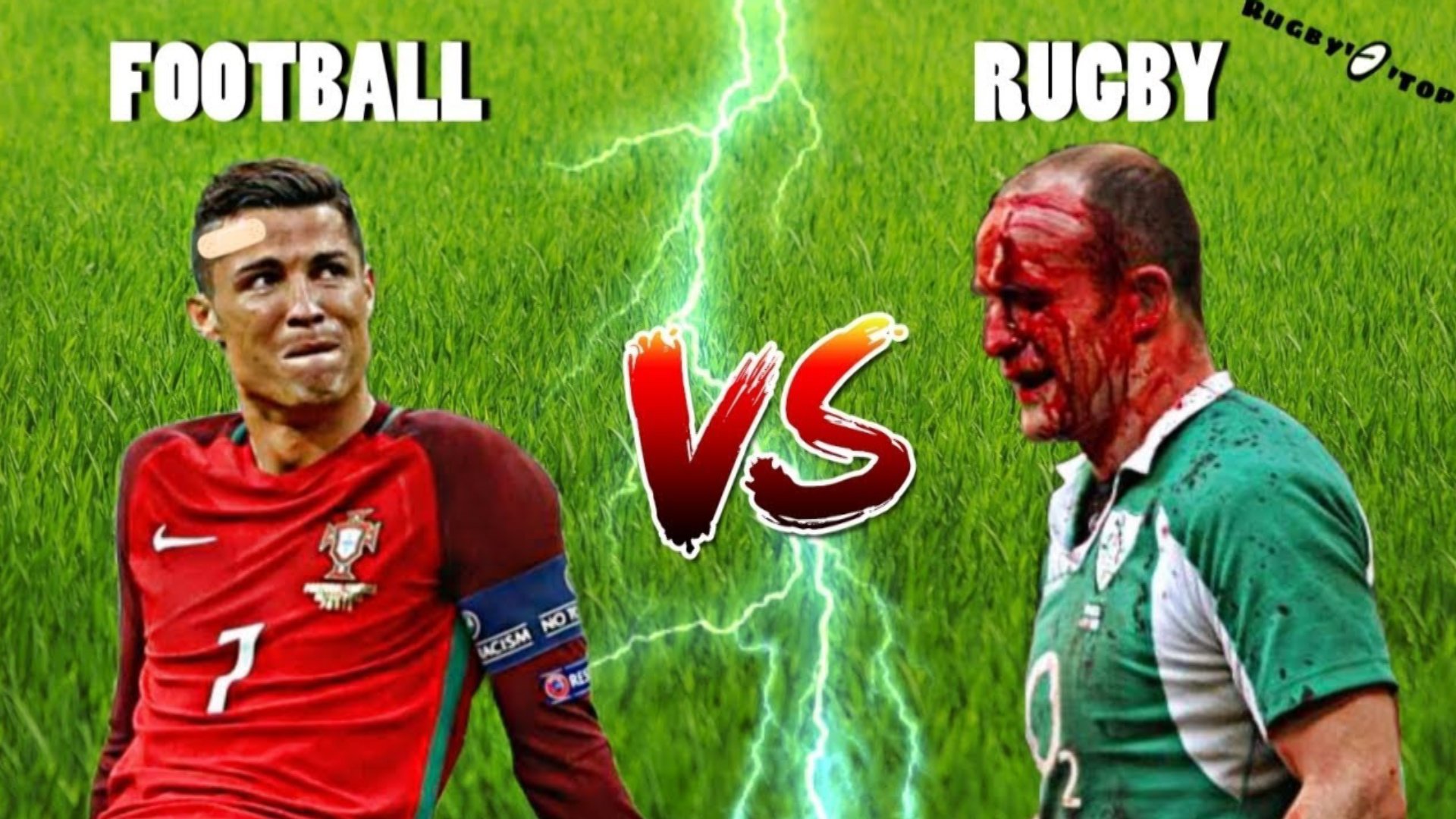
With the FIFA World Cup just around the corner, football is once again arguing about referees, VAR, handballs, offsides, and whether the referee's cousin once looked suspiciously at a player from the opposing team.
Meanwhile rugby seems to have solved a lot of this years ago.
A few ideas football could steal:
- Only the captain is allowed to speak to the referee. Everyone else who runs over waving their arms gets an automatic yellow card.
- Referee conversations with VAR are broadcast live. No more mysterious "checking possible incident..." for 5 minutes.
- Speaking of those 5 minutes... When someone is injured, or needs a substitution, etc, the clock is stopped. Let's play 2x40mins instead of 2x45, but make it "clean time".
- Anyone pretending to be injured must spend the next 10 minutes off the pitch recovering from their "serious injury". Without a substitution.
- Players who surround the referee are moved back 10 metres, rugby-style. Keep complaining and the goal is eventually awarded from the halfway line.
- Respect for officials becomes normal again instead of a revolutionary concept.
- Personally, I'd also introduce a new law (yep, in rugby they're called Laws): every fake dive earns the player a mandatory screening of their own highlights in front of the stadium after the match.
What else should football borrow from rugby?

Friday Offtopic. What rules could football adopt from rugby?
Jun. 5th, 2026 09:45 pmabomvubuso posting in talkpoliticsWith the FIFA World Cup just around the corner, football is once again arguing about referees, VAR, handballs, offsides, and whether the referee's cousin once looked suspiciously at a player from the opposing team.
Meanwhile rugby seems to have solved a lot of this years ago.
A few ideas football could steal:
- Only the captain is allowed to speak to the referee. Everyone else who runs over waving their arms gets an automatic yellow card.
- Referee conversations with VAR are broadcast live. No more mysterious "checking possible incident..." for 5 minutes.
- Speaking of those 5 minutes... When someone is injured, or needs a substitution, etc, the clock is stopped. Let's play 2x40mins instead of 2x45, but make it "clean time".
- Anyone pretending to be injured must spend the next 10 minutes off the pitch recovering from their "serious injury". Without a substitution.
- Players who surround the referee are moved back 10 metres, rugby-style. Keep complaining and the goal is eventually awarded from the halfway line.
- Respect for officials becomes normal again instead of a revolutionary concept.
- Personally, I'd also introduce a new law (yep, in rugby they're called Laws): every fake dive earns the player a mandatory screening of their own highlights in front of the stadium after the match.
What else should football borrow from rugby?
Canada in the EU?
Jun. 2nd, 2026 09:26 pmairiefairie posting in talkpoliticsThere has been some renewed discussion recently about whether Canada could one day move closer to, or even potentially join, the European Union. The idea was indirectly revived after comments from Finnish President Alexander Stubb during talks in Ottawa, where he highlighted Canada's strong alignment with the EU in terms of values, trade cooperation, defense coordination, and broader geopolitical outlook:
https://www.cbc.ca/news/politics/alexander-stubb-finland-carney-meeting-9.7164014
At present, this remains a purely theoretical discussion. Canada is not in Europe, and EU membership rules are clearly defined around geography and political integration. However, the conversation is less about formal eligibility today and more about what kind of international alignment might make sense in the long term.
( Read more... )
https://www.cbc.ca/news/politics/alexander-stubb-finland-carney-meeting-9.7164014
At present, this remains a purely theoretical discussion. Canada is not in Europe, and EU membership rules are clearly defined around geography and political integration. However, the conversation is less about formal eligibility today and more about what kind of international alignment might make sense in the long term.
( Read more... )
Job Search: Beginning Anew Every Day
Jun. 2nd, 2026 08:08 amdewlineSo I started the new search properly yesterday. I think I got a lot done, even though the progress is never immediately obvious.
I did get one bite right off, but the web software used to test for French language skills was having trouble working with my browser. As the company involved is one that I like working with and hope to work with again - and they're actively working to resolve the issue to our mutual satisfaction - I don't think I'm going to name them here.
Also, before my contract ended, I decided to finally get a license for Fontlab. I'd been wanting that for decades.
Decades.
Because I already have a Typetool 3 license, I was able to get upgrade pricing. Not much of a discount, true, and I am okay with that. I've resumed work on a pet font design project going back a couple of decades inspired by background stuff in DC Comics' Legion of Super-Heroes series.
I did get one bite right off, but the web software used to test for French language skills was having trouble working with my browser. As the company involved is one that I like working with and hope to work with again - and they're actively working to resolve the issue to our mutual satisfaction - I don't think I'm going to name them here.
Also, before my contract ended, I decided to finally get a license for Fontlab. I'd been wanting that for decades.
Decades.
Because I already have a Typetool 3 license, I was able to get upgrade pricing. Not much of a discount, true, and I am okay with that. I've resumed work on a pet font design project going back a couple of decades inspired by background stuff in DC Comics' Legion of Super-Heroes series.